Strategies for Multi-Cloud Infrastructure
What is multi cloud?
Research shows that nearly 90% of companies use multi-cloud environments. Only a small percentage of organizations still rely solely on their on-premises infrastructure. Most organizations now deploy business applications across a diverse set of cloud environments, leveraging services in diverse locations, using Public cloud SaaS, Edge, and co-location options. Only 5% of organizations are NOT utilizing some type of “as a service” offerings today. Five largest cloud service providers are Microsoft Azure, Google Cloud, Amazon Web Services, Oracle Cloud, IBM.
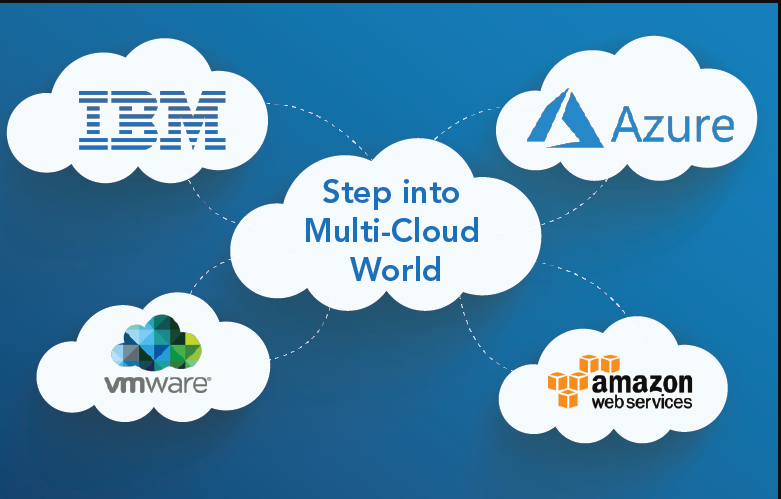 Source: https://www.linkedin.com/pulse/multi-cloud-strategy-infi-it-llc-rq97c
Multi-cloud offers flexibility and redundancy. It allows businesses to choose the best services from different providers. Organizations can tailor their multi-cloud setup to utilize services that best suit resource-heavy applications or regulatory obligations. Lets take an example, consider a Financial services firm that utilizes multi-cloud services:
- AWS: Host the main banking application and manage core transaction processing with high security and scalability.
- Google Cloud: Use for real-time fraud detection using advanced machine learning models.
- Azure: Deploy AI-driven customer support chatbots to improve user experience and reduce response time.
- IBM Cloud: Utilize IBM Cloud’s blockchain for secure and transparent audit trails of financial transactions.
This multi-cloud strategy helps the firm enhance security, improve customer service, and ensure compliance with financial regulations. Customization helps improve overall IT performance and reduce risk exposure. Multi-cloud architecture enhances disaster recovery capabilities, providing a more balanced and resilient cloud strategy. Replicating data and enabling failover across multiple cloud providers ensures business continuity. It avoids dependency on a single vendor. Multicloud is a prudent strategy for modern IT infrastructure.
Key Benefits
- Avoids vendor lock-in
- Benefit from competitive pricing
- Efficient workloads distribution
- Leverage the best of each cloud service
- Easily scale up or down based on demand
- Fosters agility and resilience in cloud operations
Managing multi-cloud environments presents several challenges, particularly when it comes to integration, observability, data consistency and security management.
Key Challenges and Resolution Strategies
Architectural Complexity: Complexity arises from the need to design, manage, and optimize infrastructure that spans across multiple cloud providers, hybrid setups, and on-premises systems. This complexity is compounded by the need to balance performance, security, cost, and compliance across disparate platforms.
Leading to increased operational overhead, difficulty in troubleshooting. These issues often span across multiple technological domains, networking, automation, data analytics, disaster recovery, and security. Making it necessary to retain specialized personnel having experience in multiple cloud services.
To navigate these challenges, implement modular architectural design, automated provisioning with infrastructure-as-code (IaC), and centralized monitoring tools to maintain control, visibility, and scalability across the entire multi-cloud ecosystem.
- Steep learning curve: Organisations often face skill gaps due to the complexity of managing multiple cloud platforms, each with unique tools, APIs, and workflows. IT teams may struggle with mastering provider-specific services, automation tools, and security policies, leading to inefficiencies, increased risk of misconfiguration, and delays in deployment.
Prioritize training programs, cross-training initiatives, invest in bulding talent pool with cloud experts to bridge these gaps and ensure the team remains proficient in managing the evolving multi-cloud landscape.
- Tool Fragmentation: IT teams often end up using a variety of tools from different vendors to manage infrastructure, security, monitoring, networking, and application deployment. Each provider offers its own set of tools, APIs, and management consoles. This fragmentation leads to inconsistent workflows, increased operational overhead, and reduced efficiency, as administrators must constantly switch between tools with varying interfaces and capabilities.
It is advisable to adopt cloud-agnostic tools (Terraform, Ansible, Prometheus), centralized monitoring platforms, and unified orchestration systems to streamline operations and maintain consistency.
- Network Latency and Connectivity Issues: A global enterprise using AWS in the US and Azure in Europe may experience increased latency or inter-region connectivity failures. Latency can arise from inter-cloud communication, cross-region data transfers, or inefficient routing paths. This can lead to slow response times, increased operational costs, and reliability concerns. Leading to degraded application performance and poor user experience.
Focus on implementing network optimization strategies, such as cloud-native peering services, CDN integration, NLBs, and traffic routing policies, to minimize latency and ensure reliable connectivity.
- Multi-cloud Integration: Interoperability issues can hinder seamless communication, data exchange, and workflow automation between different cloud platforms, services, and on-premises systems. Each cloud provider uses proprietary APIs, data formats, and service models, which can lead to inconsistent interfaces, data silos, and increased complexity in orchestration. This can result in delays in deployment, reduced operational efficiency, and higher maintenance costs.
Leverage standardized APIs, middleware solutions, and cloud-agnostic tools (Kubernetes, Terraform, Ansible) to ensure consistent and efficient integration across all cloud platforms.
- Design Security Policies: Consist security policies are critical for maintaining a unified and secure infrastructure across all platforms, as each provider may have its own default configurations, access models. Without uniform security policies, there is a risk of misconfigurations, inconsistent access controls, and potential vulnerabilities.
Enforce centralized policy management, use cloud security posture management (CSPM) tools, and implement automated compliance checks to ensure that security policies, such as Identity and Access Management, encryption standards, and logging are uniformly applied across all cloud environments. This reduces risk and simplifies audit and compliance processes.
- Compliance related losses
It becomes significantly more challenging due to the distributed nature of data storage, processing, and access across multiple cloud providers and regions. Each cloud provider may have different data residency laws, encryption capabilities, and compliance frameworks (GDPR, HIPAA, SOC 2). This can lead to data fragmentation, increased risk of non-compliance, and difficulty in enforcing consistent data governance policies.
Non-compliance with regulations can lead to financial and reputational losses. It is recommended to ensure that data classification, encryption at rest and in transit, access controls, and audit trails are uniformly applied across all cloud platforms to mitigate risks and maintain regulatory alignment.
- Identity and Access Management
Each cloud provider has its own IAM system (AWS IAM, Azure AD, Google Cloud IAM), which can lead to fragmented access policies, duplicate user management, and increased administrative overhead. Without centralized governance, these issues can become a major operational and security risk due to the proliferation of user identities across multiple cloud platforms.
It is recommended to implement federated identity solutions, enforce least-privilege access models, and use tools like SAML, OAuth 2.0, and Single Sign-On (SSO) to maintain consistent and secure access across all cloud environments.
- Events Monitoring and Response Security issues emerge from the distributed nature of infrastructure, the sheer volume of data generated, and the need to correlate events across multiple platforms, regions, and services. Without a unified monitoring and alerting system, teams risk delayed detection of issues, inconsistent alerting, and fragmented incident response.
Implement centralized monitoring tools (Prometheus, Grafana, Splunk), log aggregation systems, and automated incident response workflows to ensure real-time visibility, rapid triage, and consistent remediation across all cloud environments.
- Disaster Recovery (DR): Recovering from a disaster across multiple cloud providers, requires a comprehensive strategy that accounts for the distributed nature of workloads, data, and dependencies spread across regions. Unlike traditional single-cloud DR, multi-cloud DR must address cross-cloud failover, data replication across providers, and latency-sensitive recovery time objectives (RTOs).
While designing DR plans include automated failover mechanisms, detailed SOPs, regular testing of recovery processes, and replication strategies that align with business continuity goals. This ensures minimal downtime and data loss in the event of a disruption.
Key takeaways
- Align the infrastructure with strategic business objectives, such as cost optimization, scalability, and regulatory compliance.
- Implement automation for provisioning and orchestration using industry-standard tools like Terraform and Kubernetes to ensure consistency and reduce operational risk.
- Deploy comprehensive monitoring and analytics solutions to maintain visibility over performance, cost efficiency, and security across all cloud environments.
- Strategically distribute workloads across cloud providers based on their specialized capabilities to maximize performance and cost-effectiveness.
- Enforce unified security policies and leverage Cloud Security Posture Management (CSPM) tools to ensure compliance and mitigate risks across the cloud ecosystem.
- Utilize centralized management platforms to maintain control, visibility, and governance over the entire cloud infrastructure.
- Continuously assess and refine the multi-cloud strategy to ensure alignment with evolving business requirements and technological advancements.
Sources
- https://medium.com/@mike_tyson_cloud/seamless-architecture-building-true-multi-cloud-architectures-using-infrastructure-as-code-iac-dfc7b59521b1
- https://www.backblaze.com/blog/multi-cloud-strategy-architecture-guide/
- https://www.redhat.com/en/blog/a-guide-to-creating-a-true-hybrid/multi-cloud-architecture-with-ossm-federation
- https://www.f5.com/glossary/multi-cloud-strategies
- https://www.talend.com/resources/multi-cloud-integration/